Arizona Cactus Garden in Stanford

Transport Yourself to Arizona, Stanford’s Arizona Garden 

Why Stanford’s Arizona Garden a blooming cactusis also called Cactus Garden is quite obvious when you come closer. Here are more than 500 species of cacti and succulent. In fact, these species are from around the world, not just local to Arizona.

I was there when some of them were in bloom; what a spectacular site!

While lizards are native they tend to be rare to find, but here you have a great chance to see them. We saw at least three on our little excursion.

another cactusYou can find this free garden between Campus Drive and Arboretum Road. It  is a bit of a hidden treasure; when I asked about this in the visitor center, the students had to ask around to find out where it was.

Have you ever been to this garden?  What did you think?

Do you have another favorite public garden?

History is Just a Walk in the Park, Alum Rock

History is Just a Walk in the Park, Alum Rock

So, California’s first municipal state park is right around our corner, Alum Rock in San José founded in 1872.

Spring in Alum RockIn the 1930’s this park was well known for its mineral springs. Having over 20 different springs with minerals like magnesium and sulfur and naturally carbonated soda springs, a few doctors at the time attested their health benefits. The park also once had a natatorium, a heated indoor pool, plus about 50 mineral baths that pumped in the sulfur water right from the springs. Build in 1912 this was the major attraction in the park. It was closed after 1970, and only a plate remains where it used to be.

While doing the short mineral springs trail you can see the grottos once built around the springs to identify and protect them. And look for the tiled tubs that were holding tanks to warm up the water that was piped to the bathhouses for the actual baths.An old grotto at Alum Rock

But Alum Rock is also San José’s largest park, with various hiking trails, a lot of different picnic areas, a playground, a beach volleyball court and the Youth Science Institute.

Parking within the park is $6.

What is your favorite historic site?

A stand at the flea market

Go Bargain Hunting, De Anza College Flea Market

Flea markets are great places to find bargains. It makes me feel great whenever I find something that I get a deal on. (Also, this is the only place I feel comfortable actually doing bargaining.)

I love these peacocks!The De Anza College (http://www.deanza.edu/fleamarket/) in Cupertino has a huge flea market every 1st Saturday of the month. Parking is $5 on campus. This is the real deal, you can shop for anything and you get the professional vendors mixed in with the regular folks. Great place for buying plants, I got a rare tomato for $2!


This is a community fundraiser for student activities and programs. Do you need any more reasons?


Which one is your favorite flea market?

foot prints of an animal, at the Junior Museum and Zoo, Palo Alto

Visit a Little People Museum and Zoo, Palo Alto Junior Museum and Zoo

The Palo Alto Junior Museum and Zoo  is probably something for the younger generation (toddler to about eight), my 11 year old felt for most of this like been there – done that. The suggested donation is $5 per person, which I think is very reasonable.

You first walk thru the touch and learn exhibit, where the little ones can turn and twist and move things. Next are the insects. I have to admit I am not usually a fan of creatures with more than four legs but here they are mostly in the height for your two year old to inspect.

giant turtle

Outside there are some local animals from snakes to bunnies (not in the same pen) to a giant turtle.

pretent to be a spider on this claiming netI think my 11 year old appreciated the climbing and balancing things best.  But for younger kids this is a real cool place to hang and learn.


Do you have a favorite zoo?

Hole #2 at Hellyer Disc Golf course

Frisbee + Being in the Woods = Disc Golf

It is a simple equation, but needs a bit of prep work. Go to your favorite sport store and get yourself a starter kit for disc golf. They run at about $20. It will usually contain a driver, a midrange and a putter frisbee.

Then go to a disc golf course, there are a few courses in the Bay Area, and throw your frisbees around. To find one course near you  go to http://www.dgcoursereview.com/browse.php.

We recently went to Hellyer Park again, a well maintained 9-hole course.

You can play for free the first times, but should consider dashing out the $25 yearly fee to the Silicon Valley Disc Golf Club: http://svdgc.org, which pays for a yearly membership that is tax deductible. Other courses might charge you a Green Fee, so this is a pretty good deal!

Disc golf basket
In this basket you shall throw.

You are still wondering what it is? Well, disc golf is similar to golf as an advancement through a course with different baskets to reach. It is much easier than golf and a lot of fun.

If you are looking for a casual sport that is not too strenuous but gets you out to have some fun with friends you might want to consider disc golf.


Have you ever played disc golf before?


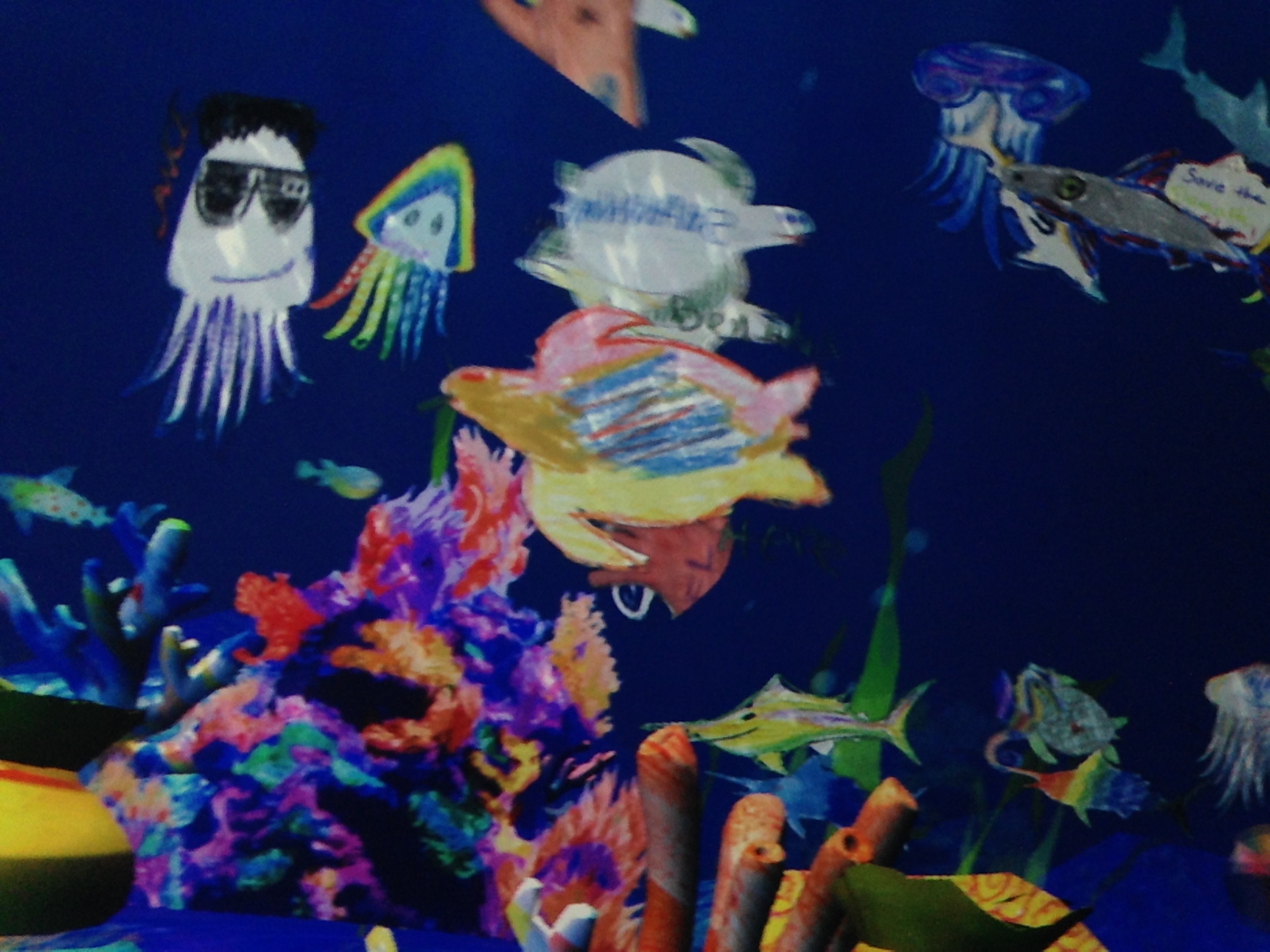
interactive art from teamLab

Immerse Yourself in an Art Experience, teamLab

Recently I went to see the teamLab exhibition Living Digital Space and Future Parks at the Pace Art + Technology pop-up gallery in Menlo Park.

20 installations by teamLab, a Japanese new media arts collective, let you truly interact with art.  Some objects react to your touch; in one you can download  a web site app to control multiple plant inspired lights and another one creates a room magically filled with flowers and butterflies that surround you. But my personal highlight was the kids’ section. There are five truly interactive installations. For example your fish drawings, once scanned in, swim away. Try to touch the screen aquarium, it’s interplay!

IMG_3632

The exhibit will run thru July 1st 2016 and is open Tuesdays – Sundays 11-7.

A great new approach to art and very fitting for Silicon Valley.


Have you seen other examples of interactive art?

Tide Pool group looking for swimming creatures

Look Who’s Swimming, Tide Pooling

As a kid I once did a Wattwanderung (mud-flats walking) when we stayed on Sylt, a Northern Sea island. When I signed up for our tide pool walk with the Marine Science Institute  I had the old images in my head of the creatures who appeared just as you pulled back the sand.

So, I was quite surprised to see the interesting rock formations that we walked on and explored. Not too rough a terrain, but you needed closed toe shoes, something that could get wet, and you needed to dress in layers.bucket full of hermit crabs and one shrimp

Rules for tide pooling are: Always watch your kids, and NEVER turn your back on the waves! And of course: Take only memories, leave only footprints.


We saw sea stars (below), a little black crab, a shrimp, and of course hermit crabs. Sea star eating something

Overall this was an exciting excursion. Our very knowledgeable tour guides from the Marine Science Institute brought buckets and nets and knew the names of the creatures and where to look. This made it a perfect day.


What was the coolest thing you’ve seen on the beach?

Keep Donkeys Safe sign

Go See the Donkeys, Bol Park

One of my favorite movie quotes is: ”I’m a flying, talking donkey!”

I was very surprised to learn that the real donkey that ‘donkey’ was modeled after lives in Palo Alto!

There are currently two donkeys on the pasture behind Bol Park (http://www.barronparkdonkeys.org/):

Perry, a minuture donkey, was the model for ‘donkey’ in the movie Shrek. Niner, a standard donkey, came to greet us when we were visiting.

Donkey Niner
What a beautiful smile

He has really soft fur and I think a beautiful smile.

I learned from their website that they take the donkeys each Sunday morning out to Bol Park where they can graze on the lawn.

If you have smaller children you might also enjoy the big playground in Bol Park.


Have you seen any other movie stars in the Bay Area lately?

Hanging out with Elephant Seals

Hanging out with Elephant Seals

There are two options I am aware of to see elephant seals up close.
First is Año Nuevo State Park and also Piedras Bianca near San Simion.
In order to see the seals in Ano Nuevo you have to book a tour online that, if you want to pick times that suit you, you probably have to book about two weeks in advance. I think the $7 per person plus $10 for parking was well spent. On a 2 ½ hour hike we learned a lot about the seals and came up close to watch the little babies get nursed.

Piedras Bianca has a short, more accessible, walk up to a viewing point where a park ranger answers questions. Here no reservation is necessary but a donation is appreciated.  

Female elephant seal taking a rest at Año Nuevo State Beach.

January/February are probably the most visited months for the state park to see the elephant seals. Breeding season is from late December till early February. In March the adults leave their pubs behind. Yes! Imagine that. The pubs tech themselves to swim and will depart in April to swim up north.

Mature females will be somewhat pregnant after about 24 days after giving birth, they do a delayed implantation which means the fertilized egg will not be implanted in the wall of the uterus for another four month.

Another unbelievable fact is that the females don’t eat anything while they give birth, nurse and breed, and the males go without food for up to three months while they are on land mating.

Do you know of any other places to watch elephant seals in the Bay Area?

Los Trancos Open Space Preserve

Earthquake Trilogy

Living along the San Andreas Fault sometimes feels like living on the edge. (Excuse my pun)

Recently we learned a lot about earthquakes. While the exhibit in the Tech Museum in San José was the most descriptive, the two earthquake trails we walked were especially good for exercise, and made it feel more real.

In the Tech Museum, I liked the platform that reenacts different quakes the best. The three earthquakes I experienced so far all had slightly different motions. On the platform in the Tech Museum it confirmed that it wasn’t just me feeling it, they are different!

Point Reyes National Park has an earthquake trail which is about a 30 minute loop. It’s near the visitor center for Bear Valley, which I also highly recommend for exploring.

It was great for the kids to read out their descriptions

On the trail are two different signposts, one for adults and one for kids. They also had markers to follow along the fault. The most impressive one is a fence that did a 16 feet jump during the 1906 quake.


This shows the two parts of the fence 16 feet apart.

The other earthquake trail is a 1.5 mile hike in Los Trancos Open Space Preserve. http://www.openspace.org/preserves/los-trancos We picked up a brochure (you can also see the  PDF here: https://earth.stanford.edu/sites/default/files/San_Andreas_Fault_Trail.pdf) at the main parking lot. The 9 station long walk in with more than 2000 feet elevation was more scientific than Point Reyes but with some spectacular views.

Sign for the Fault Trail

We had problems finding the things in the description. There was also a fence that had been put there as an example, but it was only 3 feet apart.


Do you know of any examples for Earthquakes in the area? Have you ever felt an earthquake?